
Hancock County Court Records After Arrest
After an arrest in Hancock County, the booking record and court record are separate. Booking starts at the Hancock County Detention Center when jail staff enter identity, arresting agency, intake charge, bond or hold status, and other jail data. The court record starts when a charge is filed, moved, accused, indicted, amended, dismissed, or disposed in court. That court file becomes the better source for prosecutor-filed charges, hearing dates, orders, motions, plea entries, sentence terms, and final disposition.
The first custody check belongs with the jail, especially when the arrest is new and a case number may not exist yet. The Hancock County Sheriff's Office, led by Sheriff Tomyln Primus, is the local jail contact source; the filed-case route belongs with the Hancock Superior Court Clerk and PeachCourt/eAccess access for online records. For custody and booking detail, use Hancock County jail inmate records. For booking photo questions, use Hancock County jail mugshots. Court records after a jail arrest answer a different question: what charge was filed and what happened in court.
Find Hancock County Court Arrest Records
The local court route starts with the Hancock County Superior Court Clerk. The county page says the clerk supports Superior and Juvenile Court administration and maintains civil, criminal, real estate, and other official records. The court address is 12630 Broad Street, Sparta, GA 31087, and the phone number is (706) 444-6644. Clerk LeShauna R. Jackson is listed at extension 2009 with Leshauna.jackson@gsccca.org.
Georgia's court eAccess page routes Hancock Superior Court users to PeachCourt and states that users are redirected to provider websites and must have an account. PeachCourt supports civil and criminal eFiling and court documents across Georgia, but provider search fields were not visible without account access in the research capture. If an account search does not show the case, direct clerk contact is the practical fallback.
Georgia Courts eAccess is the state route that points Hancock Superior users toward the provider path.
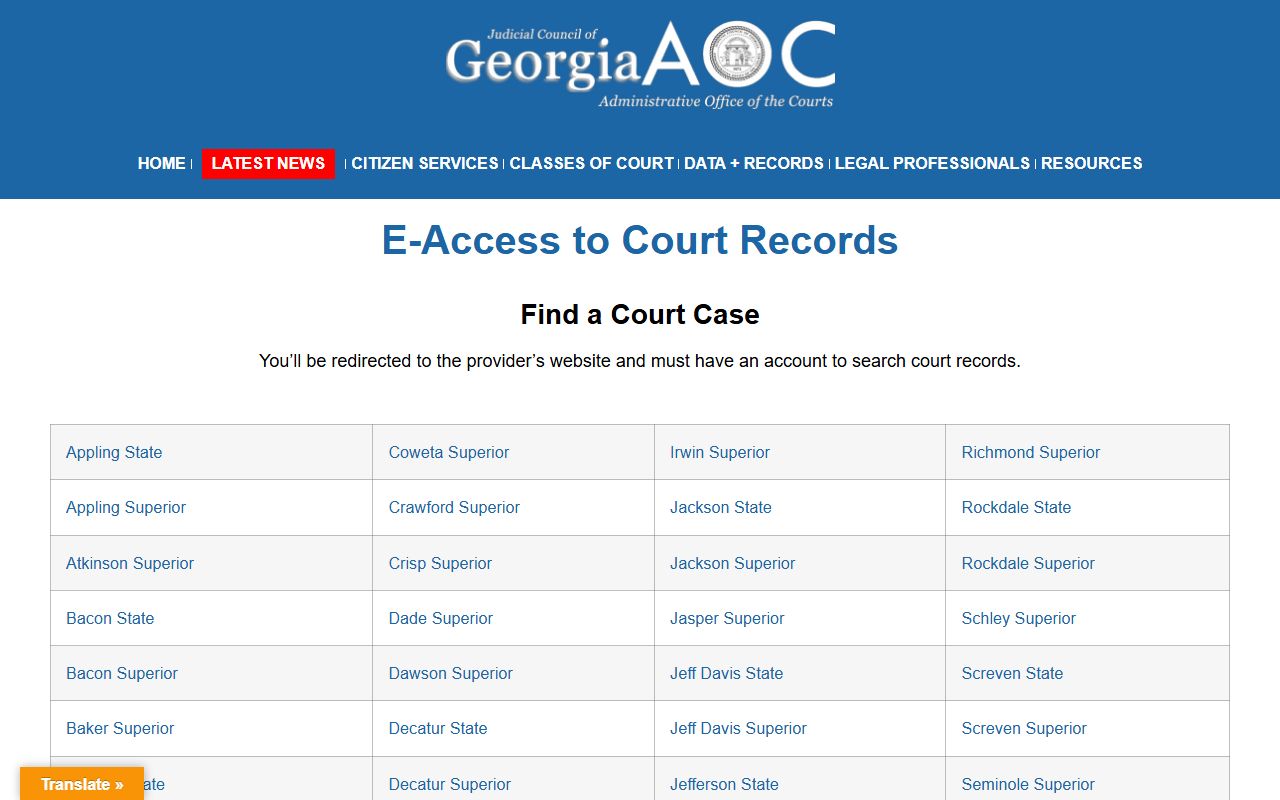
The account requirement matters because older records, restricted records, or cases not exposed through the provider may still need a clerk request.
| Field Label | Type | Required | Notes |
|---|---|---|---|
| PeachCourt Register | Link or button | Required for account creation | Account access is part of the Georgia Courts eAccess route. |
| Login credentials | Text and password | Required for account access | The provider interface is not a fully open anonymous index in the captured material. |
| Court/provider selection | List or link | Required | Georgia Courts lists Hancock Superior under PeachCourt. |
| Case search fields | Not fully captured | Unspecified | Do not assume exact labels without provider login inspection. |
Search Court Records After Arrest
A court search after a Hancock County jail arrest should follow the record path, not just the date of arrest. The case may not be visible the same day a person is booked. Magistrate Court can be involved early for bonds, warrants, first appearances, and pretrial services, while Superior Court is the main felony court record route once criminal filings move forward.
- Confirm current custody and basic booking status with Hancock County Detention Center if the arrest is recent.
- Ask whether a first appearance has occurred and which court is handling the next event.
- Check Hancock Superior Court records through the clerk or the Georgia eAccess route to PeachCourt.
- Search by defendant name or case number only where the provider or clerk supports those fields.
- Open the case record and compare charge counts, charge descriptions, filing dates, bond orders, and hearing entries.
- For prosecution decisions, contact the Ocmulgee Judicial Circuit District Attorney if the clerk record does not answer whether a charge was dismissed, reduced, or amended.
Hancock County Arrest Charging Records
Charging documents explain why court records after a jail arrest can differ from booking records. A complaint or warrant may support an arrest and early probable-cause review. An accusation is a prosecutor-filed charging document. An indictment is a grand-jury charging document. In felony matters, the Ocmulgee Judicial Circuit District Attorney evaluates reports, evidence, warrants, and referrals before deciding which charges to pursue.
| Document | Who Uses It | What It Means |
|---|---|---|
| Complaint or warrant | Law enforcement, prosecutor, or judicial officer | Often tied to arrest, probable cause, and the early court stage. |
| Accusation | Prosecutor | Formal charging document often used when an indictment is not required or is waived. |
| Indictment | Grand jury | Formal charge returned by a grand jury, often important in felony prosecution. |
Hancock County Charge Status Records
Charge status is the court record's way of showing movement. A charge can be pending, amended, reduced, dismissed, nolle prossed, no billed, or resolved by plea or verdict. A booking charge is only the jail intake allegation. Prosecutor-filed charges can be different after review, and a final disposition can be different again.
| Status | What It Means |
|---|---|
| Pending | The charge has been filed or remains active and has not reached final resolution. |
| Amended | The filed charge was changed after the original filing. |
| Reduced | The charge was lowered to a lesser offense or lower level. |
| Dismissed | The charge ended by court or prosecutor action. |
| Nolle prosequi | The prosecutor declined or abandoned prosecution of that charge. |
| No bill | A grand jury did not indict on the charge presented. |
Bond Records After Jail Arrest
The Hancock County courts directory says Magistrate Court handles bonds and pretrial court services. That makes Magistrate Court important early in the arrest-to-court path, especially before a felony case is fully filed in Superior Court. For a new arrest, call the jail first to ask whether bond has been set, what type of bond is allowed, and whether another hold prevents release. A court order controls release terms, but the jail can often tell whether the person is still physically held.
| Bond Type | How It Works |
|---|---|
| Cash bond | The full cash amount is posted with the proper court or jail authority, if accepted. |
| Surety bond | A licensed bondsman or surety posts the bond when the court allows it. |
| Property bond | Qualified property may secure release when court rules allow it. |
| PR or own recognizance | The court authorizes release based on a promise to appear, often with conditions. |
| No-bond hold | Payment alone does not authorize release until the court or holding agency changes the status. |
Note: A bond amount does not always mean release is available because another county, probation, parole, GDC, ICE, or federal hold can block release.
Hancock County Charge vs Conviction
Being arrested and charged is not the same as being convicted. Court records after a jail arrest may show allegations that are still pending or later dismissed. A conviction occurs only after a guilty plea, verdict, or other qualifying finding. This distinction matters for records use, reputation, and any later request to restrict access to eligible Georgia records.
| Point | Charge | Conviction |
|---|---|---|
| Stage | An accusation or allegation in the court process. | A final guilt finding by plea or verdict. |
| Proof level | Based on probable cause or prosecution filing standards. | Requires proof beyond a reasonable doubt or a guilty plea. |
| Can change | Can be amended, reduced, dismissed, nolle prossed, or no billed. | Can affect sentence, probation, and later record history. |
| Best source | Court docket, charging document, clerk file, and DA status. | Court disposition, sentence order, and clerk record. |
Restricted Hancock County Arrest Records
Georgia uses record restriction language rather than a simple universal expungement rule for every case. Some records may be restricted after dismissal, non-referral for prosecution, no bill, acquittal, or other eligible disposition. Other records may stay public. Juvenile records, sealed records, protected victim or witness information, medical information, and some investigative material can also be withheld or limited under public-records rules.
| Concept | Sealed or Restricted | Expunged |
|---|---|---|
| Public visibility | Public access is limited or blocked for eligible records. | The record is treated as removed or no longer available in the way the law allows. |
| Georgia wording | Record restriction is the key Georgia term in many situations. | Use caution because not every record is destroyed. |
| Law enforcement access | Some official access may remain. | Access depends on the statute and order involved. |
| Best contact | Clerk, prosecutor, or the agency that created the record. | Clerk or qualified legal counsel for eligibility questions. |
Hancock County Court Arrest Contacts
The clerk and prosecutor have different roles. The clerk maintains criminal court records and can route file-access questions. The District Attorney handles prosecution decisions in the Ocmulgee Judicial Circuit, including whether a felony charge proceeds by indictment or accusation and whether a charge is dismissed, reduced, or amended.
Hancock Superior Court Clerk
12630 Broad Street
Sparta, GA 31087
(706) 444-6644
Monday-Friday, 9:00 a.m.-5:00 p.m.
Clerk: LeShauna R. Jackson, ext. 2009
Leshauna.jackson@gsccca.org
Ocmulgee Judicial Circuit District Attorney
166 Industrial Blvd.
Gray, GA 31032
(478) 986-3166
District Attorney: T. Wright Barksdale III
Serves Hancock County and other circuit counties.
The Ocmulgee Judicial Circuit District Attorney page identifies the prosecutor serving Hancock County.
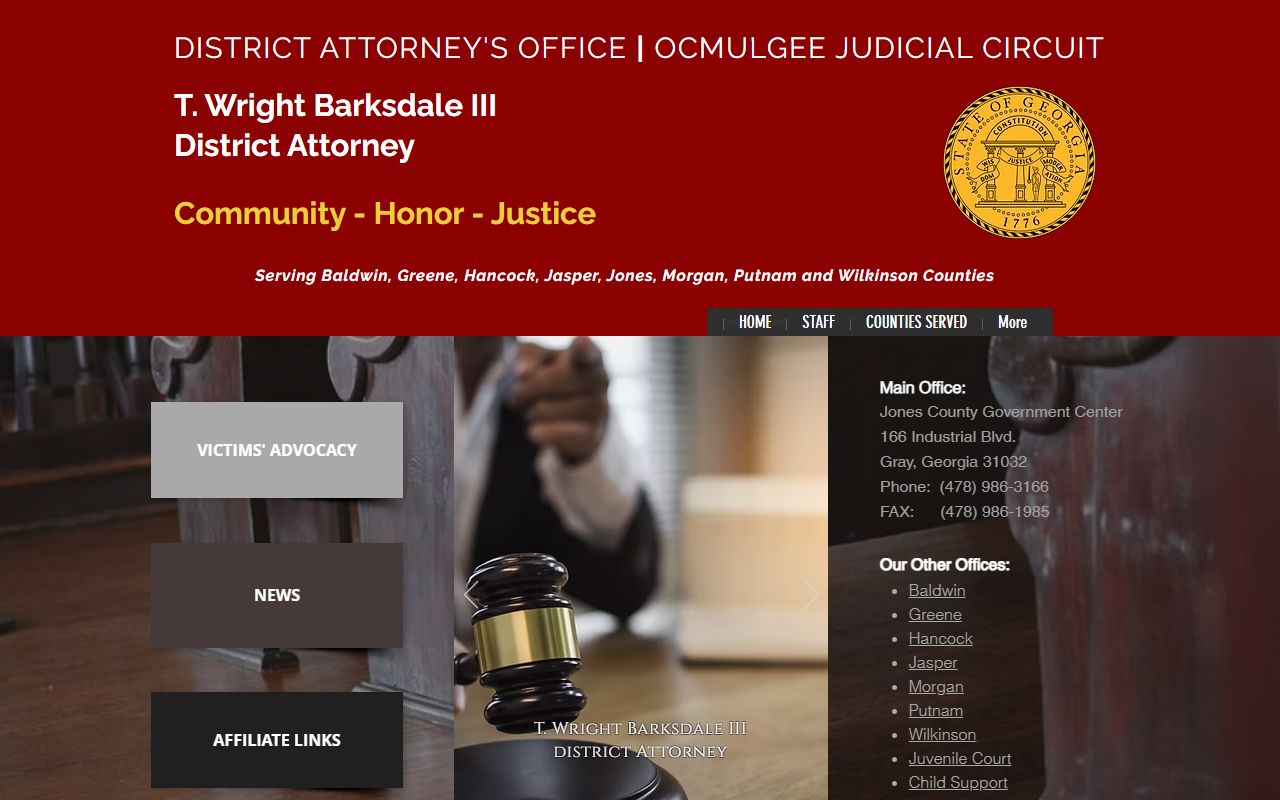
The DA contact is useful when a court record shows a charge status but the prosecution decision needs direct confirmation.
Court Records and Background Use
Casual public-record lookup is different from a formal background check. A court file can help a reader understand what happened after a Hancock County jail arrest, but it should not be used as a consumer report for employment, credit, housing, insurance, licensing, or any other FCRA-regulated decision. Official case records can also be incomplete in one source if the case is old, restricted, not yet filed, or still moving through the court process.
Important: Court records can show charges before final disposition, so verify the current status with the clerk or court file.